
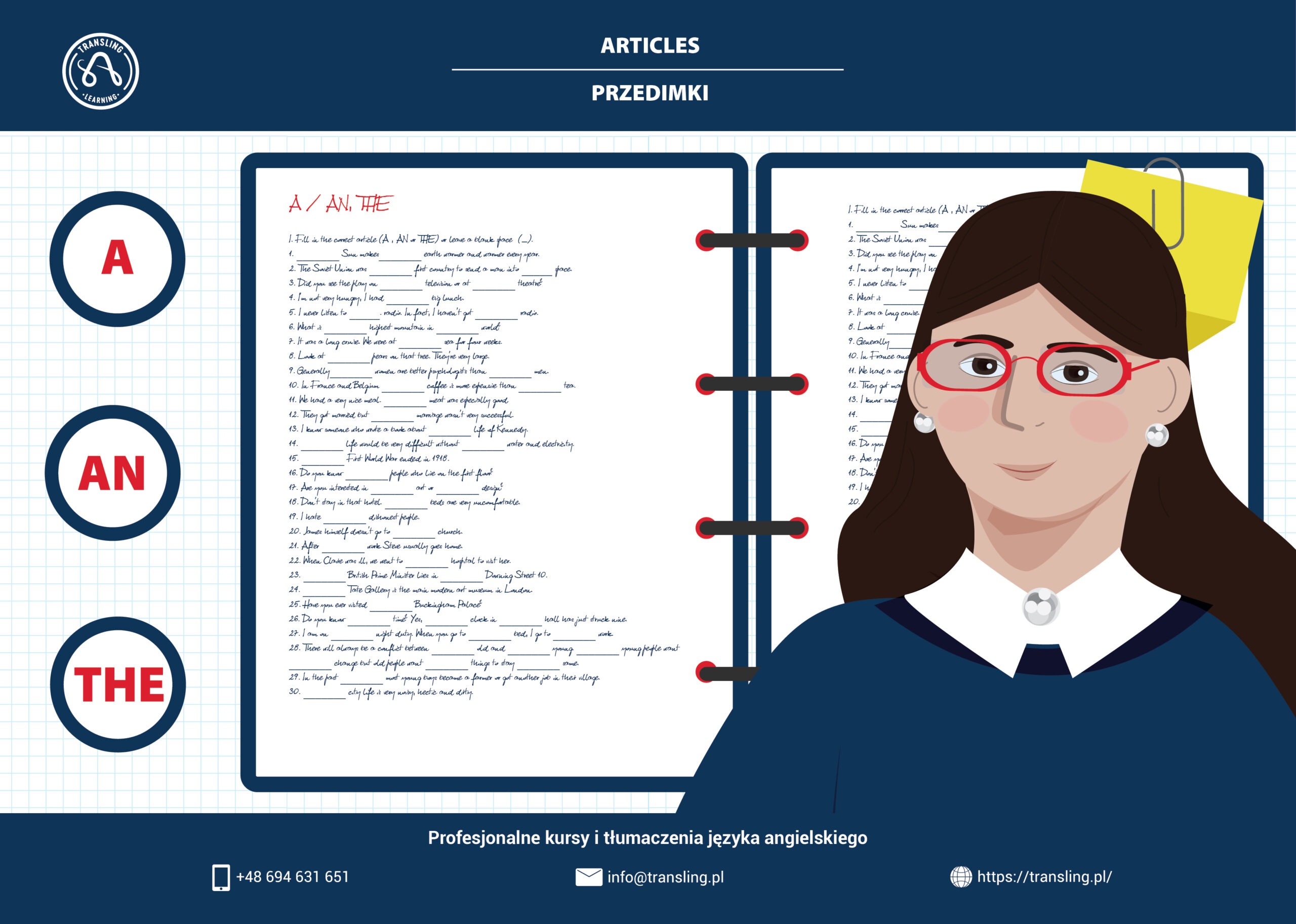
Articles czyli przedimki
Przedimki w języku angielskim czyli tzw. articles to jedno z najbardziej problematycznych zagadnień, które wydają się przysparzać najwięcej problemów zarówno na początku nauki jak i w jej trakcie, na średnich i najwyższych poziomach zaawansowania. Co więcej, nawet rodzimi użytkownicy języka tzw. native speakers nierzadko miewają problemy z ich poprawnym zastosowaniem.
Co prawda są to elementy składowe zdania lub wyrażeń, które same w sobie nie wnoszą żadnego szczególnego znaczenia lecz niewłaściwe ich użycie może czasem wprowadzić w zakłopotanie lub nieporozumiemie a zatem lepiej zapoznać się lepiej z przedimkami.
Poniżej przedstawiam kilka zasad użycia przedimków.
Przedimki dzielimy na nieokreślone a, an oraz określone the.
Articles in the English language are one of the most problematic issues that cause the most problems both at the beginning of learning and during it, at intermediate and advanced levels. Moreover, even native speakers of the language often come across problems with their correct use.
Although they are components of a sentence or expression that do not carry any special meaning in themselves, their incorrect use can sometimes cause embarrassment or misunderstanding, so it is better to familiarize yourself with articles better.
Below I present a few rules for the use of articles.
Articles are divided into indefinite a, an and definite the.
PRZEIMKI NIEOKREŚLONE: A / AN
Przedimka a/an używamy przed rzeczownikami policzalnymi w liczbie pojedynczej wtedy, gdy traktujemy daną osobę lub przedmiot indywidualnie i nie interesuje nas, o którą dokładnie osobę lub rzecz chodzi, np.:
I’ve got a new car.
Mam nowy samochód. = Nie określam marki tylko ogólnie mówię, iż posiadam samochód.
Carlos has a new girlfriend.
Carlos ma nową dziewczynę. = Jakąś dziewczynę, nie mamy na myśli konkretnej osoby.
!!! a/an nie występuje przed rzeczownikami niepoliczalnymi i rzeczownikami w liczbie mnogiej.
a – stawiamy przed rzeczownikami, które zaczynają się od* spółgłoski np. a cat, a table, a door
an – stawiamy przed rzeczownikami, które zaczynają się od* samogłoski an apple, an umbrella, an eye
* Przy decyzji czy użyć „a” czy „an”, ważna jest wymowa danego rzeczownika. Jeśli piszemy przez samogłoskę, ale wymawiamy spółgłoskę trzeba użyć „a”, np:
a university /ˌjuːnɪˈvɜːsəti/
an hour /aʊə /
Przedimków używamy również przed całym wyrażeniem rzeczownikowym tzn. przymiotnik + rzeczownik.
Jeśli rzeczownik opisany jest przez przymiotnik, przedimek stawiamy przed pierwszym przymiotnikiem.
a beautiful house
a red double-decker bus
a tall girl
PRZEDIMEK OKREŚLONY: THE
The używamy:
-
przed rzeczownikami wtedy, gdy mamy na myśli konkretną osobę lub rzecz, a osoba z którą rozmawiamy wie, o kim lub o czym mówimy.
Open the door.
Otwórz drzwi. (Kiedy wiemy o które drzwi chodzi.)
The man in the white suit is a lawyer.
Mężczyzna w białym garniturze jest prawnikiem.
(W naszym polu widzenia jest tylko jedna mężczyzna w białym garniturze i właśnie jego mamy na myśli).
-
jako reprezentanta całej grupy np.:
The tiger (reprezentant całego gatunku, wszystkie tygrysy na świecie)
The Bengal tiger is an endangered species.
-
przed przymiotnikiem dla określenia grupy społecznej lub narodowości np.
The poor (biedni, wszyscy biedni ludzie na świecie)
The unemployed (bezrobotni, cała grupa bezrobotnych)
The French (Francuzi)
The British (Brytyjczycy)
zawsze w nazwach:
-
mórz i oceanów – the Atlantic, the Baltic Sea
-
łańcuchów górskich – the Himalayas, the Alps
-
rzek i kanałów – the Vistula, the Thames; the English Channel
-
państw, gdy zawierają w swojej nazwie rzeczownik własny lub występują w liczbie mnogiej- the United Kingdom the Netherlands, the United States, the United Arab Emirates
-
zatok – the Gulf of Mexico, the Bay of Biscay
-
galerii i muzeów – the British Museum, the National Gallery
-
kin oraz teatrów – the Odeon, the Globe
-
pałaców – the Buckingham Palace
-
niektórych gazet i czasopism – the Sun, the Daily Mirror, the Observer, the
-
w takich wyrażeniach jak:
in the morning, in the afternoon, in the evening, at the theatre, at the cinema, at the station, at the bank, play the piano, the guitar (instrumenty po czasowniku play), at the weekend, in the world, all over the world
!!! Nie używamy THE:
-
przed rzeczownikiem w liczbie mnogiej gdy mówimy o jakiś rzeczach w ogóle np.
Men and women have different tastes and preferences.
There are a lot of cats and dogs in my neighbourhood.
-
przed wyrażeniami z last oraz next np.
next week, next Monday, last week, last Friday
-
przed rzeczownikami abstrakcyjnymi np. wyrażającymi uczucia, stany emocjonalne np.
Love and happiness are very important things in most people’s lives.
-
przed wyrażeniami z go jeśli używamy ich w celu do jakiego służą:
go to school, go to college/university, go to church, go to prison, go to hospital np.
He goes to school every day to learn systematically.
He goes to church every Sunday because he is very religious.
She went to prison last year for killing her husband.
John went to hospital last week to have an operation on his spine.
Natomiast jeśli powyższe wyrażenia występuję w innej roli niż tej do której są przeznaczone, wówczas wstawiamy the przed rzeczownikiem np.
She went to the school last Friday to attend the parents’ meeting.
They went to the church yesterday to repair the roof.
She wants to go to the prison to visit her husband.
I’d like to go to the hospital tomorrow to see my grandmother.
w nazwach:
-
kontynentów – Africa, Europe
-
ulic – Oxford Street
-
państw – Poland, France, Spain
-
jezior – Lake Michigan
-
miast – Paris, London, Budapest (wyjątek: the Hague)
-
pojedynczych gór – Mount Everest
-
parków – Hyde Park, St James’s Park
A teraz czas na zastosowanie przedimów w praktyce. Oto kilka ćwiczeń:
I. Fill in the correct article (A , AN or THE) or leave a blank space (–).
1. _______ Sun makes_______ earth warmer and warmer every year.
2. The Soviet Union was _______ first country to send a man into _____ space.
3. Did you see the play on _______ television or at _______ theatre?
4. I’m not very hungry, I had _______ big lunch.
5. I never listen to _____. radio. In fact, I haven’t got _______ radio.
6. What is _______ highest mountain in _______ world?
7. It was a long cruise. We were at _______ sea for four weeks.
8. Look at _______ pears on that tree. They’re very large.
9. Generally_______ women are better psychologists than _______ men.
10. In France and Belgium _______ coffee is more expensive than _______ tea.
11. We had a very nice meal. _______ meat was especially good.
12. They got married but _______ marriage wasn’t very successful.
13. I know someone who wrote a book about _______ life of Kennedy.
14. _______ life would be very difficult without _______ water and electricity.
15. _______ First World War ended in 1918.
16. Do you know _______ people who live on the first floor?
17. Are you interested in _______ art or _______ design?
18. Don’t stay in that hotel. _______ beds are very uncomfortable.
19. I hate _______ dishonest people.
20. James himself doesn’t go to _______ church.
21. After _______ work Steve usually goes home.
22. When Claire was ill, we went to _______ hospital to visit her.
23. _______ British Prime Minister lives in _______ Downing Street 10.
24. _______ Tate Gallery is the main modern art museum in London.
25. Have you ever visited _______ Buckingham Palace?
26. Do you know _______ time? Yes, _______ clock in _______ hall has just struck nine.
27. I am on _______ night duty. When you go to _______ bed, I go to _______ work.
28. There will always be a conflict between _______ old and _______ young. _______ young people want
_______ change but old people want _______ things to stay _______ same.
29. In the past _______ most young boys became a farmer or got another job in their village.
30. _______ city life is very noisy, hectic and dirty.
II. Fill in the gaps with THE when necessary.
-
______youngest boy has just started going to_____school; ______eldest boy is already at____college.
-
She lives on____top floor of an old house. When_____wind blows, all_____windows rattle.
-
_____darkness doesn’t worry cats; ____cats can see in_____dark.
-
He was sent to____prison for_____six months for_____shoplifting. When_____six months are over, he’ll be released; _____difficulty then will be to find_____work. ~ Did you go to____ prison to visit him?
-
____Amazon is the biggest river in South America.
-
I would like to meet _____President of ____USA in person.
-
I’ve never been to______Bahamas.
-
He buys_____Times every morning.
-
Did you visit_____Eifffel Tower when you went to France last year?
-
I never drive to _____office. I always go on____foot.
-
______June is my favourite month of ____year.
-
She speaks _____Portuguese language fluently.
-
I would like to go to_______Adriatic Sea this summer.
-
In a few weeks _____Johnsons are going to move out.
-
She can play_____flute.
-
He learnt to play_____piano when he was six.
-
When I save more money, I would like to buy _____new scooter.
-
I’m exhausted. The only thing I want is to go to_____bed.
-
_____Taj Mahal is in India.
-
I’m afraid of_____spiders and big insects.
-
All____books on the top shelf belong to me.
-
A pacifist is someone who is againt_____war.
-
Gregory and Jessica got married, but_____marriage didn’t last very long.
-
What makes _____people violent? What causes_____aggression?
-
_____people on my street are very kind and friendly to me.
-
____apples are good for your health.
-
When was____Internet invented?
-
____giraffe is the tallest of all animals.
-
_____French are famous for their cousine.
-
_____young have the future in their hands.
-
Naples is in____south of Italy.
-
France and Britain are separated by____Channel.
-
____UK consists of four parts.
-
_____Seychelles are a group of islands in___Indian Ocean.
-
____River Volga flows into____Caspian Sea.
-
____Hyde Park is a very large park in central London.
-
Have you ever been to_____British Museum?
-
John works for_____BMW now.
-
One day I’d like to visit ____Great Wall of China.
-
Steven is a student at____Manchester University.
A teraz czas na zastosowanie przedimów w praktyce. Oto kilka ćwiczeń:
Ex. I
-
the, the
-
the, –
-
– , at
-
a
-
the, a
-
the, the
-
–
-
the
-
– , –
-
– , –
-
the
-
the
-
the
-
-, –
-
the
-
the
-
– , –
-
the
-
–
-
–
-
–
-
the
-
the, –
-
the
-
the
-
the, the, the
-
– , -, –
-
the, the, -, -, -, the
-
–
-
–
Ex. II
-
the, -, the, –
-
the, -, the
-
-, -, the
-
-, -, -,the, the, -, –
-
the
-
the, the
-
the
-
the
-
the
-
the, –
-
–
-
the