
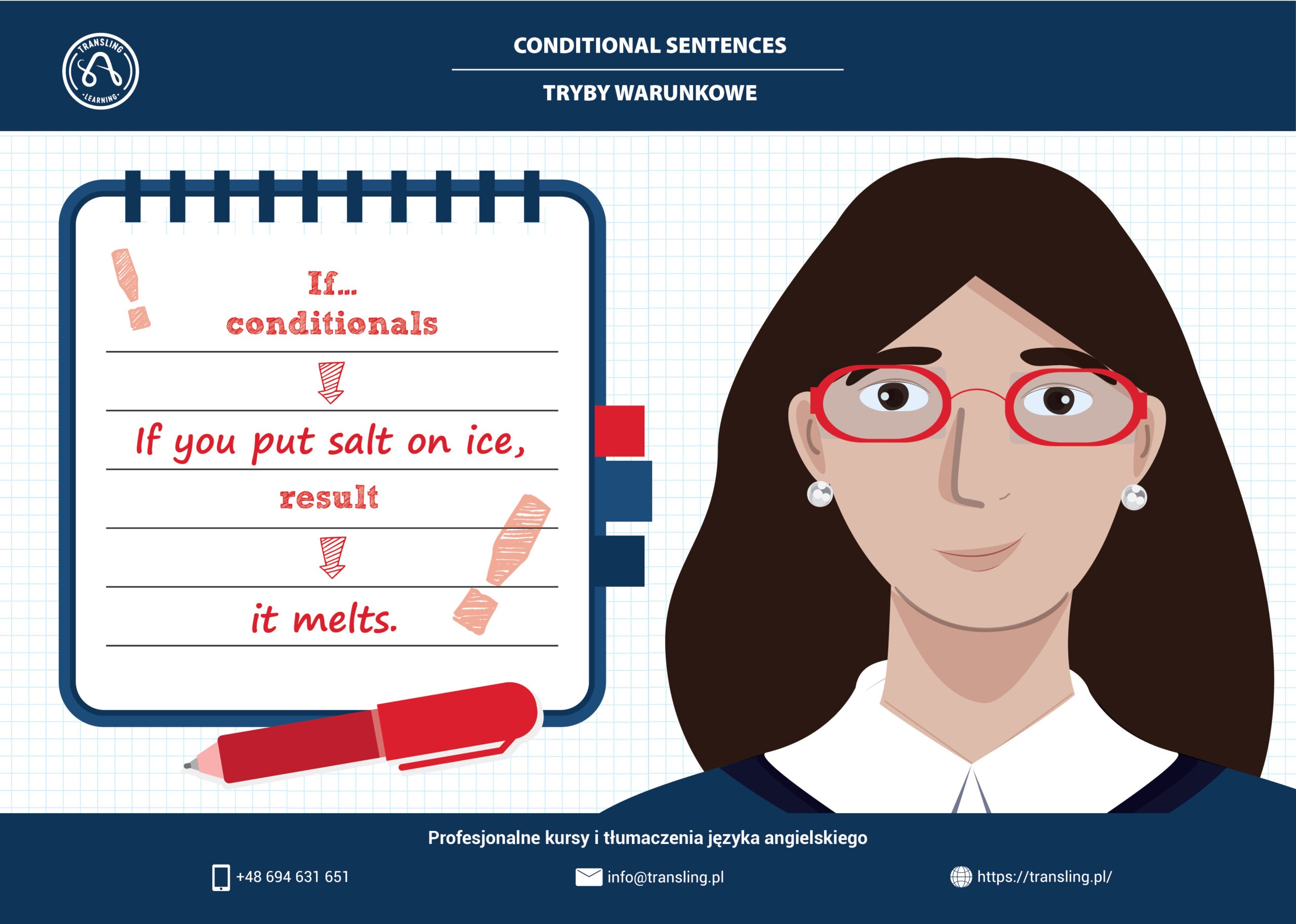
Tryby warunkowe
Conditional sentences
Tryby lub okresy warunkowe to jedne z tych zagadnień gramatycznych, które przysparzają kursantom, uczniom i studentom najwięcej problemów nawet na najwyższych poziomach zaawansowania dlatego też przyjrzyjmy się jak wyglądają poszczególne formy i ich zastosowanie w praktyce.
W języku angielskim istnieją 4 rodzaje trybów warunkowych oraz tzw. tryby mieszane, zazwyczaj stosowane w dwóch różnych konfiguracjach.
Conditional sentences are some of the grammatical issues that cause the most problems for students, even at the highest levels of linguistic competence, so let’s take a look at what the individual forms look like and how they are used in practice.
In English, there are 4 types of conditional sentences and also so-called mixed types, usually used in two different configurations.
Type O: conditions which are always true
If + present form (present simple) + present form or imperative When
Sytuacje realne, prawdziwe niezależnie od czasu. Konstrukcje te wyrażają generalne prawdy, fakty naukowe, reguły chemiczne, zjawiska biologiczne i geograficzne ─ sytuacje, które mają miejsce zawsze, kiedy spełniony jest dany warunek.
Real and true situations, regardless of time. These constructions express general truths, scientific facts, chemical rules, biological and geographical phenomena – situations that always occur when a given condition is met.
e.g. When / If you combine oxygen and hydrogen, you get water.
Kiedy / gdy łączymy tlen z wodorem to otrzymujemy wodę.
When / If you put salt on ice, it melts.
Zerowe tryby warunkowe są to również zdania w których mówimy o trwałych lub powtarzających się czynnościach, a nie o jednorazowym zdarzeniu oraz w twierdzeniach, które są zawsze prawdą.
Zero conditionals are also sentences in which we talk about permanent or repeated actions, not a one-time event, and in statements that are always true.
e.g. Whenever / if I eat too much, I have a stomachache.
My boss gets angry when / if I am late for work.
Mój szef się złości kiedy/ jeśli spóźniam się do pracy.
Type 1: conditions which are probable in the present or future
If + present form (present simple) + future form (will/won’t + infinitive) or may/can + infinitive
Warunek, który odnosi się do przyszłości. Zdań tych używamy, gdy istnieje duże prawdopodobieństwo, że coś się wydarzy, jeśli spełniony zostanie pewien warunek.
A condition that refers to the future. We use these sentences when there is a high probability that something will happen if a certain condition is met.
e.g. If I leave now, I’ll miss the rush hour.
Jeśli teraz wyjdę to ominę godzinę szczytu.
Zamiast if…not można użyć UNLESS ( = jeśli nie...), lecz należy pamiętać, że czasownik występujęw formie twierdzącej jako, że unless samo w sobie jest przeczeniem.
Instead of if…not you can use UNLESS ( = if not…), but remember that the verb is in the affirmative form as unless is a negative in itself.
e.g. Unless we leave early, we’ll miss the 9 o’clock train.
(If we don’t leave early, we will miss…)
Type 2: conditions which are improbable or impossible in the present or future
If + past simple/continuous + would/could/might + infinitive
Warunek, który jest mało możliwy lub całkowicie nierealny i odnoszą się do teraźniejszości lub przyszłości; są to przeważnie spekulacje, dedukcje, wyobrażenia na temat tego co mogłoby się wydarzyć gdyby został spełniony określony warunek (Gdybym był bogaty… to zrobił(a)bym …)
A condition that is highly unlikely or completely unrealistic and refers to the present or future; these are usually speculations, deductions, ideas about what could happen if a specific condition were/was met (If I were/was rich… I would do…)
e.g. If you met the President of the USA, what would you say to him?
If they lived a bit nearer, we might see them more often.
Gdyby bliżej mieszkali to mogliby częściej się widywać/spotykać.
Tryb drugi wyraża również radę, zalecenia za pomocą zwrotu If I were you… (= Na Twoim miejscu…)
e.g. If I were you, I wouldn’t worry so much.
UWAGA:
Można stosować were zamiast was dla wszystkich osób w zdaniu If ….
e.g. If he were/was here, he would help us solve the problem.
Type 3 : unreal conditions in the past
If + past perfect simple/continuous + would/should/might/could + have + PP
Warunek, który nie został spełniony w przeszłości, a odnosi się również do przeszłości. Nie można odwrócić tego co już się wydarzyło w przeszłości. Zarówno wydarzenia jak i ich skutki są widoczne w przeszłości.
A condition that was not fulfilled in the past, and also refers to the past. You cannot undo what has already happened in the past. Both events and their effects are visible in the past.
e.g. If the telephone hadn’t woken me up, I would have been late for my appointment.
Gdyby telefon mnie nie obudził to spóźniłbym się na spotkanie (lecz było odwrotnie).
She could have gone to university if she’d wanted to.
MIXED CONDITIONALS = Tryby mieszane
I. Unreal conditions in the past with an unreal present or future result.
If past perfect simple/continuous + would/should/might/could + infinitive
TYPE 3 TYPE 2
Kiedy sytuacja z przeszłości wpływa na teraźniejszość lub przyszłość, stosujemy mieszankę trybu trzeciego z drugim, np.:
When a past situation influences the present or future, we use a mixture of the third and second conditional type, e.g.:
e.g. If you had driven faster, we could be here by now.
If she hadn’t decided to change jobs, she would be going to China next month.
If you hadn’t yelled at her yesterday, she wouldn’t be angry with you now.
Gdybyś na nią wczoraj nie wrzeszczał to teraz nie byłaby na ciebie zła.
II. Unreal conditions in the present with an unreal past result.
If past simple/continuous + would/should/could/might + have + PP
TYPE 2 TYPE 3
Kiedy sytuacja odbywająca się w teraźniejszości mogłaby mieć wpływ na przeszłość, stosujemy mieszankę trybu drugiego z trzecim, np.
When a situation taking place in the present could have an influence on the past, we use a mixture of the second and third conditional type, e.g.
e.g. If I didn’t trust him, I wouldn’t have let him look after the baby.
If I spoke Japanese, I might have got that job.
Gdybym mówiła po Japońsku (ale nie mówię nadal), to dostałabym tę pracę (wtedy, w przeszłości, była taka możliwość)
CONDITIONAL LINKS = łączniki warunkowe
Oprócz if można stosować inne alternatywne słowa lub wyrażenia, które również wyrażają warunek:
In addition to if, you can use other alternative words or phrases that also express a condition:
unless
as / so long as
providing / provided (that)
suppose / supposing (that)
on condition (that)
PUNCTUATION = interpunkcja
Kiedy forma z if wystepuje w pierwszym zdaniu podrzędnym, wówczas wstawiamy przecinek (,). Natomiast jeśli if znajduje się w drugiej części całego zdania, wówczas nie wstawiamy żadnego przecinka.
When the if form appears in the first subordinate clause, we use a comma (,). However, if the if form appears in the second part of the entire sentence, we do not use any comma.
e.g. If you ask him, he may help you do your homework.
He may help you do your homework if you ask him.
INVERSION = inwersja
W sytuacjach formalnych IF można pominąć całkowicie a następnie odwrócić kolejność wyrazów czyli zastosować tzw. inwersję, wtedy should (conditionals type 1), were (conditionals type 2) and had (conditionals type 3) wstawiamy przed podmiot.
In formal situations, IF can be omitted completely and the order of the words can be reversed, i.e. the so-called inversion can be used, then should (conditionals type 1), were (conditionals type 2) and had (conditionals type 3) are placed before the subject.
E.g.
If you should see her, ask her to come to the party.
Should you see her, ask her to come to the party.
If I were you, I wouldn’t worry so much.
Were I you, I wouldn’t worry so much.
If I had known how to say it in Portuguese, I wouldn’t have had all these problems.
Had I known how to say it in Portuguese, I wouldn’t have had all these problems.
If Mike had been here, he would’ve lent me some money.
Had Mike been here, he would’ve lent me some money.
EXERCISES
A teraz czas na sprawdzenie powyższych treści w praktyce. Oto kilka prostych ćwiczeń na zdania warunkowe:
And now it’s time to check and put the theory into practice. Here are some simple exercises for conditional sentences:
I. Put the words in the correct order to make conditional sentences.
take / you / tablet / will / down / feel / if / better / a / you / lie / and
You_______________________________________________________________
them / impolite / and / if/ him / people / ignores / he / are / to / says / simply / nothing
If people___________________________________________________________
didn’t / take / she / breathing / cycling / problems / have / she / would / up / if
She________________________________________________________________
meeting / the / if / hurry / late / David / we / be / doesn’t / up / will / for
If David____________________________________________________________
apologise / I / her / were / you / would / if / to
I_________________________________________________________________
II. Choose the correct form of the verb.
If I go to bed after midnight, I am always / I’ll always be / would always be tired in the morning.
I don’t / won’t / wouldn’t tell you anything if you can’t keep a secret.
If he could speak good Spanish, he finds / will find / would find a well-paid job in Madrid.
I don’t / won’t / wouldn’t trust these people if I were you.
Thomas comes / will come / would come if you promise not to talk about school all the time.
Is it / Will it / Would it be all right if I used your mobile phone for a while as I forgot mine?
III. Complete the gaps with the correct form of conditional sentences.
If you_____________(not be) careful, you’ll burn yourself.
Would you go to the head teacher if they___________(start) bullying you again?
I_________________(not lend) him any money even if I had some as I don’t trust him.
If she _____________(have) a choice, she always chooses vanilla ice-cream.
I would be delighted if he________________(ask) me out.
If you heat ice, it ______________(turn) into water.
What will you do if she_____________(decide) not to come after all?
Listen kids: if you_________________(not behave) properly, you won’t get your dessert.
Would you know what to do if you _____________(lose) your passport or some other document on holiday abroad?
If Kevin invites me to his party, I_______________(not accept) his invitation.
I would have read the letter if I ____________________ (know) it was from you.
If William doesn’t help in the garden, I ____________________ (not finish) my work in time.
If you ____________________ (not tell ) me about Frank’s birthday, I would have forgotten it.
We _________________________ (catch) the train earlier if Mary hadn’t spent so much time choosing what to wear.
If Susan ____________________ (learn) the poem, she would know the answer now.
If I ________________(have) more time, I would go to the gym more often.
If it _______________ (not rain) today, I would rather go to the nearby mountains than stay at home.
If the Professor spoke clearly, we __________________________ (understand) him better.
If you go on talking like that, we ____________________ (throw) you out of the room.
If Steve ____________________ (go) home now, he would meet his cousin who has just arrived.